Thyroid Ablation vs Thyroid Embolization: Which Is Right for You?
Being diagnosed with a thyroid nodule can be worrying. Many patients are immediately told that surgery is the only solution, which often raises concerns about neck scars, hospital stay, lifelong thyroid medication, and possible complications.
What many people do not realise is that most thyroid nodules are benign and do not always need surgery. Today, modern minimally invasive treatments can reduce thyroid nodules without removing the thyroid gland—depending on the size of the nodule, its blood supply, and the symptoms it causes.
Two such treatments are thyroid ablation and thyroid embolization. While both aim to reduce thyroid nodules without surgery, they work in different ways and are suited to different patients.
Understanding these options helps patients make informed decisions and avoid unnecessary surgery when possible.
What Is a Thyroid Nodule?
The thyroid is a small gland located at the front of the neck. A thyroid nodule is a lump that forms within this gland. Many people have thyroid nodules without any symptoms and may never realise they have one.
Some nodules remain small and harmless, while others may grow and cause:
- A visible swelling in the neck
- A feeling of pressure or tightness
- Difficulty swallowing
- Cosmetic concerns
- Changes in energy levels in some individuals
Importantly, most thyroid nodules are not cancerous.
What Is Thyroid Ablation?
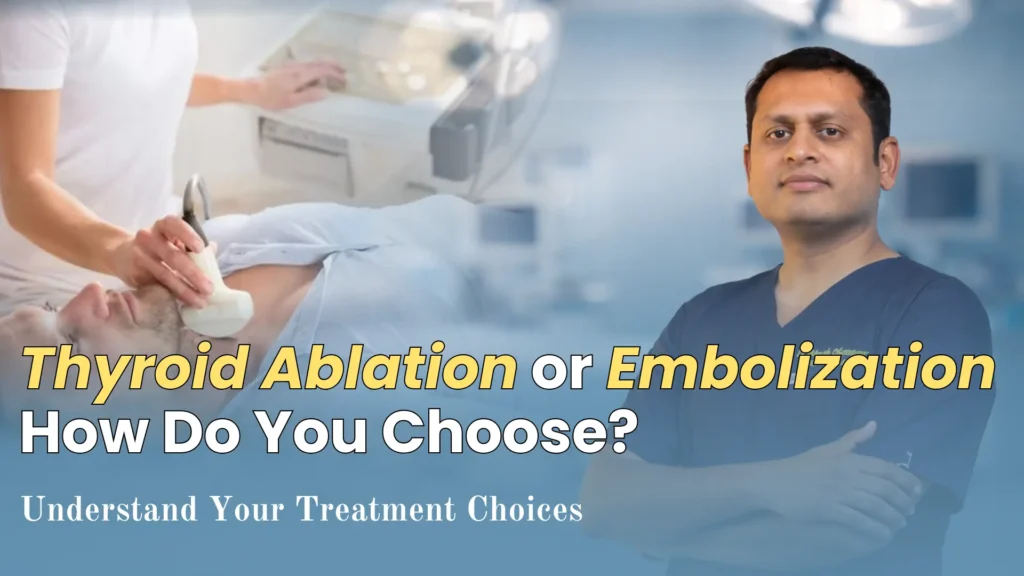
Thyroid ablation is a non-surgical treatment used to reduce the size of a benign thyroid nodule. Under ultrasound guidance, a thin needle is inserted directly into the nodule. Controlled heat is then applied from within the nodule to treat it.
There is no surgical cut, and the thyroid gland itself is preserved. Over time, the treated nodule gradually shrinks, relieving symptoms such as swelling, pressure, or discomfort. Recovery is usually quick, with minimal pain.
Benefits of Thyroid Ablation
Thyroid ablation offers several advantages for suitable patients:
- No surgery and no neck scar
- Day-care procedure with short hospital stay
- Preserves normal thyroid tissue
- Very low risk of hypothyroidism
- Quick recovery and early return to daily activities
- Effective reduction in nodule size and symptoms
- Improvement in cosmetic appearance and pressure symptoms
For many patients, thyroid ablation helps avoid lifelong thyroid hormone medication.
Limitations and Possible Side Effects of Thyroid Ablation
Although safe and effective, thyroid ablation may not be suitable for everyone:
- Very large nodules may not shrink sufficiently with ablation alone
- Nodules with very high blood supply may respond less effectively
- Mild pain, tenderness, or swelling may occur for a few days after the procedure
- Thyroid ablation is not recommended if cancer is suspected
Who Is Thyroid Ablation Best Suited For?
Thyroid ablation is usually considered when:
- The nodule is benign (confirmed by biopsy)
- The nodule is solid or predominantly solid
- There are pressure symptoms (difficulty swallowing, neck discomfort)
- There is visible neck swelling causing cosmetic concern
- Thyroid hormone levels are normal
- The patient wishes to avoid surgery
It is an excellent option for patients seeking thyroid nodule treatment without surgery.
What Is Thyroid Embolization?
Thyroid embolization, also called Thyroid Artery Embolization (TAE), is another minimally invasive treatment. Instead of treating the nodule directly, this procedure works by reducing the blood supply to the thyroid nodule or gland.
When blood flow is reduced, the nodule gradually shrinks over time. This technique is particularly useful for large nodules or enlarged thyroid glands (goiter).
Benefits of Thyroid Embolization
Thyroid embolization may be preferred because:
- It can reduce large thyroid swellings
- It avoids surgery and neck scars
- It is useful for highly vascular nodules
- It can help control symptoms related to hormone overactivity
Limitations and Possible Side Effects of Thyroid Embolization
Possible risks include:
- Short-term neck pain or discomfort
- Temporary changes in thyroid hormone levels
- Slightly higher chance of needing thyroid medication later compared to ablation
- Rare risks such as bleeding, infection, nerve injury, or stroke (uncommon)
Most patients recover well without serious complications.
Thyroid Ablation vs Thyroid Embolization: Key Differences
Feature | Thyroid Ablation | Thyroid Embolization |
How it works | Heat destroys the nodule | Blood supply to nodule/gland is blocked |
Target | Individual thyroid nodule | Nodule or larger thyroid area |
Best suited for | Small–medium benign solid nodules | Large or highly vascular nodules / goiter |
Precision | Very high | Moderate |
Effect on hormones | Minimal | Hormone levels may fluctuate |
Risk of hypothyroidism | Very low | Slightly higher |
Role in hyperthyroidism | Limited | Very useful |
Neck scar | None | None |
Recovery time | 1–2 days | 2–3 days |
Preferred when | Cosmetic or pressure symptoms | Large size, vascularity, or high surgical risk |
How Is the Right Treatment Chosen?
There is no single treatment that suits everyone. The best option is decided after careful evaluation of:
- Size of the thyroid nodule
- Growth over time
- Symptoms such as pressure, swallowing difficulty, or cosmetic concerns
- Blood supply to the nodule
- Thyroid hormone levels
- Age, overall health, and patient preference
Radiofrequency ablation (RFA) is usually ideal for patients with a single, benign thyroid nodule.
Thyroid embolization is better suited for patients with multiple nodules, very large nodules, or goiter.
The goal is always to relieve symptoms while preserving normal thyroid function.
When Is Surgery Still Needed?
Despite advanced non-surgical options, surgery remains necessary when:
- Thyroid cancer is suspected or confirmed
- Very large goiters cause airway compression
- Multiple nodules cause severe symptoms
- The patient prefers surgery after counselling
What Should You Do Next?
If you have a benign thyroid nodule or thyroid enlargement, it is important to know that surgery is not the only option. Thyroid ablation and thyroid embolization have helped many patients manage these without removing the thyroid gland.
The next step is to consult a specialist who can review your scans, biopsy reports, and symptoms and guide you toward the most appropriate treatment for your condition.
About the Author
Dr Vikash Chennur is the Founder and Medical Director of Vikash IR Clinic, Bangalore.
He completed his MD Radiology at the prestigious All India Institute of Medical Sciences, New Delhi, where he was awarded the Gold Medal by Manmohan Singh in 2009 for being the best radiology postgraduate resident.
Dr Chennur has completed fellowships in Vascular and Interventional Radiology from the University of Ottawa and Body (Abdominal) Imaging from the University of Calgary. He also holds FRANZCR and EBIR qualifications, reflecting extensive international expertise in interventional radiology.